
For years, digital marketing followed a relatively familiar formula:
Create content → optimise for search → rank on Google → get clicks.
That model isn’t disappearing.
But search is changing.
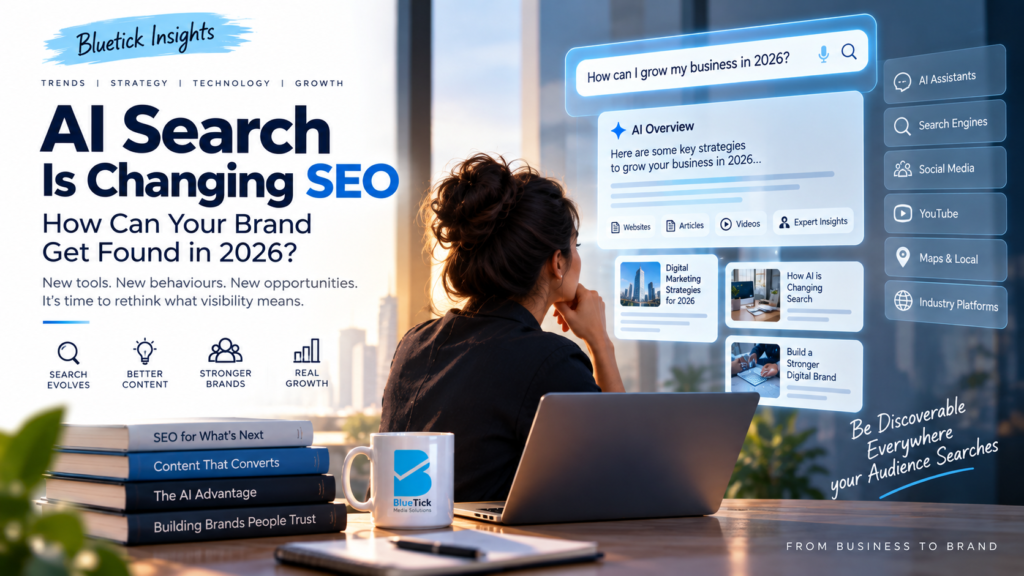
People are increasingly asking longer, more conversational questions and using AI-powered tools to research topics, compare options and make decisions.
Google has expanded AI Overviews and AI Mode as part of this shift. Google says AI Overviews now reach more than 2.5 billion monthly active users, while AI Mode has surpassed one billion monthly users. Google also says these experiences are designed to help people discover websites and continue exploring information across the web.
For businesses, this creates a new question:
How do you make your brand discoverable when the search experience itself is becoming conversational and AI-powered?
The answer isn’t to abandon SEO.
It’s to rethink what SEO is supposed to achieve.
What Is AI Search?
Traditional search generally works like this:
You ask a question → search engine returns links → you choose a website.
AI-powered search can work differently:
You ask a question → AI interprets your intent → information is synthesised → sources are presented → you ask follow-up questions.
Google’s AI Mode, for example, allows users to move from an initial search into a more conversational experience and ask follow-up questions while retaining context.
Other AI platforms such as ChatGPT, Gemini and Perplexity are also becoming part of how people research products, businesses, ideas and solutions.
This means your potential customer may discover your brand before ever typing your company name into Google.
SEO Isn’t Dead. The Search Journey Is Evolving.
Every time search changes, someone declares:
“SEO is dead.”
We’ve heard it before.
Social media didn’t kill SEO.
Mobile didn’t kill SEO.
Voice search didn’t kill SEO.
And AI isn’t simply eliminating it either.
In fact, AI search still depends heavily on the wider web ecosystem. Content needs to be discovered, understood and evaluated before it can potentially be surfaced as part of an AI-generated answer.
HubSpot’s 2026 State of Marketing research found that updating SEO for changes in search was one of the leading marketing priorities identified by marketers, while websites, blogs and SEO remain important channels.
The bigger change is that ranking is no longer the only measure of visibility.
Your brand may now need to appear across:
- Traditional search results
- AI Overviews
- AI Mode
- AI assistants
- YouTube
- Social platforms
- Local search
- Industry websites
- Online communities
Search is becoming a much larger ecosystem.
So What Is AEO?
You may have come across terms such as:
AEO — Answer Engine Optimisation
GEO — Generative Engine Optimisation
AI SEO
The terminology is still evolving.
At its simplest, the idea is this:
Make your brand and content easier for AI-powered search systems to understand, trust and potentially surface when people ask relevant questions.
AEO doesn’t replace SEO.
It builds on many of the same foundations.
That means businesses still need:
- Crawlable websites
- Useful content
- Clear information architecture
- Strong technical foundations
- Relevant internal links
- Authoritative information
- Good user experience
- Original insights
HubSpot similarly describes AI search optimisation as complementary to traditional SEO rather than a replacement for it.
What Makes Content More Useful in AI Search?
There isn’t a magic formula that guarantees an AI system will mention your business.
But there are several things businesses can do to create a stronger digital presence.
1. Answer the Questions Your Customers Actually Ask
One of the biggest mistakes businesses make is creating content around what they want to say instead of what customers want to know.
Imagine a digital marketing agency.
A conventional service page might simply say:
“We provide comprehensive digital marketing solutions.”
That’s not very useful.
Instead, a business could create content answering questions such as:
- How much does digital marketing cost for a small business?
- How long does SEO take to show results?
- Should a startup invest in Google Ads?
- How often should a business post on Instagram?
- What makes a website generate leads?
- How can a local business improve online visibility?
These questions are closer to how people actually research decisions.
And they create opportunities for a brand to demonstrate expertise.
2. Build Topical Authority
One article rarely establishes expertise.
A stronger approach is to build a content ecosystem.
For example, a business offering digital marketing services could develop a cluster of useful resources around:
SEO
→ SEO basics
→ Technical SEO
→ Local SEO
→ AI Search
→ Content strategy
→ Search analytics
And another around:
Social Media
→ Instagram strategy
→ Reels
→ Social search
→ Content planning
→ Influencer marketing
→ Community building
Instead of publishing disconnected articles, your website gradually becomes a useful resource around the subjects your business understands.
That’s valuable for people first — and gives search systems more context about what your brand actually knows.
3. Make Your Website Genuinely Informative
Your website shouldn’t only tell people:
What you sell.
It should also explain:
What you know.
A strong business website should make it easy to understand:
- What the company does
- Who it serves
- Which problems it solves
- What industries it understands
- How its services work
- What customers commonly ask
- What makes its approach different
Google’s current guidance for website owners specifically highlights the importance of unique, non-commodity content, good page experience and high-quality images and video.
In other words:
Don’t build a website simply to have a website.
Build a useful digital destination.
4. Create Original Insights
AI can generate enormous amounts of content.
That makes originality more valuable, not less.
If 100 websites publish essentially the same article about:
“10 Digital Marketing Tips”
another generic version isn’t necessarily going to make your brand memorable.
Instead, add something of your own:
- Industry experience
- Case studies
- Examples
- Data
- Expert commentary
- Original observations
- Customer questions
- First-hand experience
AI can help accelerate content production.
But expertise gives content a reason to exist.
5. Think Beyond Keywords
Keywords still matter.
But modern search behaviour is much more conversational.
Someone may not search:
“SEO agency Mumbai”
They may ask:
“What should a small business in Mumbai look for before hiring an SEO agency?”
Those are very different types of queries.
The second question contains:
- Context
- Intent
- Location
- Business situation
- A specific decision
Content that addresses the underlying question can be much more useful than content simply repeating a keyword.
This is one reason question-based and conversational content is becoming increasingly important in modern search strategies.
6. Strengthen Your Brand Everywhere
AI search isn’t happening in isolation.
Your website is one part of your digital identity.
Your brand may also be represented through:
- Social media
- Business listings
- Reviews
- News coverage
- Industry websites
- YouTube
- Customer testimonials
- Online communities
Think of these as pieces of a larger digital footprint.
A customer may encounter your brand in one place and research it somewhere completely different.
That means consistency matters.
Your:
Name + positioning + services + expertise + visual identity
should make sense wherever people encounter you.
The New Search Visibility Equation
The old SEO mindset was often:
Keywords + Links + Rankings = Traffic
The modern equation is broader:
Useful Content + Technical Foundations + Expertise + Authority + Brand Presence = Search Visibility
And search visibility itself can take different forms.
You might:
- Rank in traditional search
- Appear in an AI-generated answer
- Be mentioned by an AI assistant
- Show up in a video search
- Appear in a local result
- Be recommended through social content
- Be discovered through a third-party publication
The destination is no longer always a Google results page.
Does This Mean Businesses Should Stop Chasing Website Traffic?
Not at all.
Website traffic still matters.
Your website remains the place where you can provide detailed information, showcase your expertise, generate leads and convert interest into business.
But businesses should understand that not every valuable interaction ends with a click.
A person might encounter your brand in an AI-generated answer, remember the name and search for it later.
Another person might discover your Instagram profile, watch several videos and visit your website days later.
Someone else might read a third-party article mentioning your company and then search for your services.
The customer journey is becoming less linear.
What Should Businesses Do in 2026?
Here are five practical steps.
1. Audit your website
Make sure your important pages are accessible, useful and easy to understand.
2. Build a content strategy around real questions
Talk to customers, sales teams and employees.
Find out what people actually ask.
Then turn those questions into useful content.
3. Strengthen your expertise
Don’t just publish more.
Publish better.
Add experience, examples, insights and original perspectives.
4. Think beyond Google
Build visibility across search, social, video, communities and relevant third-party platforms.
5. Measure more than rankings
Track meaningful business outcomes alongside traditional SEO metrics.
Look at:
- Qualified enquiries
- Leads
- Conversions
- Branded searches
- Engagement
- Returning visitors
- Content performance
- Search visibility
And as AI search develops, businesses can increasingly look at how their content is surfaced across AI-driven search experiences. Google has begun introducing Search Console insights related to appearances in its generative AI search features.
The Future of SEO Isn’t About Disappearing From Search
Search isn’t disappearing.
Search is expanding.
People are using traditional search engines, AI assistants, social platforms, video platforms and online communities to discover information.
The brands that adapt don’t necessarily need to abandon SEO.
They need to build something bigger:
A digital presence designed to be discoverable wherever their customers are looking for answers.
And that requires more than keywords.
It requires useful content, technical strength, expertise, consistency and a recognisable brand.
Because ultimately, the goal isn’t simply to rank.
The goal is to be found, understood and remembered.
About Bluetick Media Solutions
At Bluetick Media Solutions, we help businesses build stronger digital brands through branding, websites, digital marketing, content, PR, SEO and AI-powered solutions.
As search continues to evolve, we believe the brands that succeed will be those that combine technology with strategy, creativity and a genuine understanding of their audience.
Because your brand deserves more than just marketing.